
I’ve burned through more software budgets than I care to admit chasing the promise of effortless rankings. If there’s one thing fifteen years in search marketing has taught me, it’s that AI SEO tools can be brilliant collaborators or expensive distractions. The difference usually comes down to whether you’re using them to think faster, or to avoid thinking altogether. Right now, the market is overflowing. Every platform from established giants to overnight startups has slapped an AI-powered label on its homepage.
But in 2025 and heading into 2026, simply generating 2,000 words of optimized prose isn’t the flex it used to be. Google’s March core update and the ongoing helpful content refinements made one thing painfully clear: search rewards depth, originality, and genuine user value. The tools that survive this era are the ones that help you deliver exactly that not just pump out keyword stuffed pages at scale.
What AI SEO Tools Actually Do Well
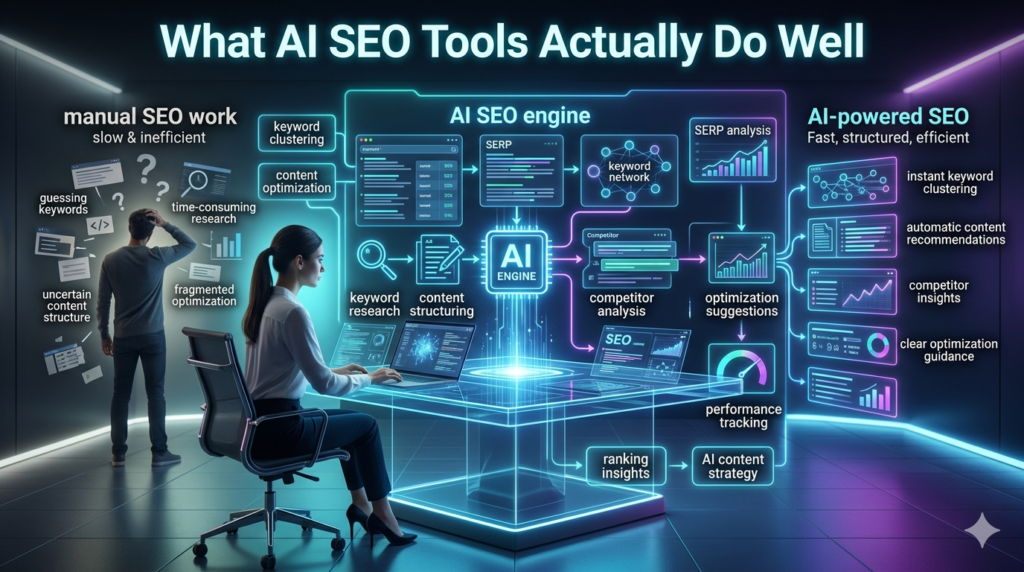
Let’s break the noise into categories. In my workflow, artificial intelligence SEO software tends to fall into four buckets: research and clustering, content optimization, technical auditing, and predictive analytics. None of them replace a strategist, but the good ones remove the grunt work that eats up 70% of my week. Take keyword research. A few years ago, clustering topics meant spreadsheets, pivot tables, and a lot of crying into coffee. Now, platforms like Ahrens and SEMrush use machine learning to group keywords by intent in minutes, not days. Last spring, I worked with a regional HVAC company that wanted to rank for everything from emergency AC repair to duct cleaning cost. Using an AI clustering tool, we mapped 800 seemingly random keywords into twelve clear content pillars.
Their organic traffic jumped 40% in four months not because the tool wrote the content, but because it revealed a structure we’d have missed manually. Content optimization tools like Surfer SEO, Clear scope, and Market Muse operate on a similar principle. They reverse-engineer what’s already ranking, then suggest semantic keywords, headings, and readability tweaks. The trick is treating their scores as guardrails, not gospel. I’ve seen writers chase a 95 optimization score and end up with robotic, repetitive copy that reads like it was assembled in a factory. The best results happen when a skilled editor uses these platforms to validate coverage gaps, not to overwrite their own voice.
Where the Hype Falls Apart
Here’s where I get skeptical. Some vendors sell AI SEO tools as if they’re digital marketing autopilot. They’re not. I tested a popular “one-click blog post” feature earlier this year for a personal project. The draft came back in under ninety seconds, technically perfect in terms of keyword density and header structure. It was also factually wrong about industry regulations, emotionally flat, and completely indistinguishable from ten other AI-generated posts targeting the same term. I deleted it. That experience highlights a critical limitation: these tools are pattern matching engines. They don’t have expertise, they have probability. If your niche requires nuance medical advice, financial guidance, legal interpretation you’re playing with fire by publishing unchecked AI output.
Beyond the ethical obligation to provide accurate information, Google’s quality raters are explicitly looking for signals of real world experience. You can’t fake that with a prompt. There’s also the over-optimization trap. When everyone uses the same AI content optimization platform, everyone’s articles start looking identical. Same H2s. Same semantic keywords. Same predictable cadence. Search engines are already getting better at detecting this sameness, and I suspect the next major algorithm shift will penalize templated content even harder. The sites that win will be the ones using AI for the busywork while humans inject perspective, storytelling, and original research.
Building a Workflow That Actually Works
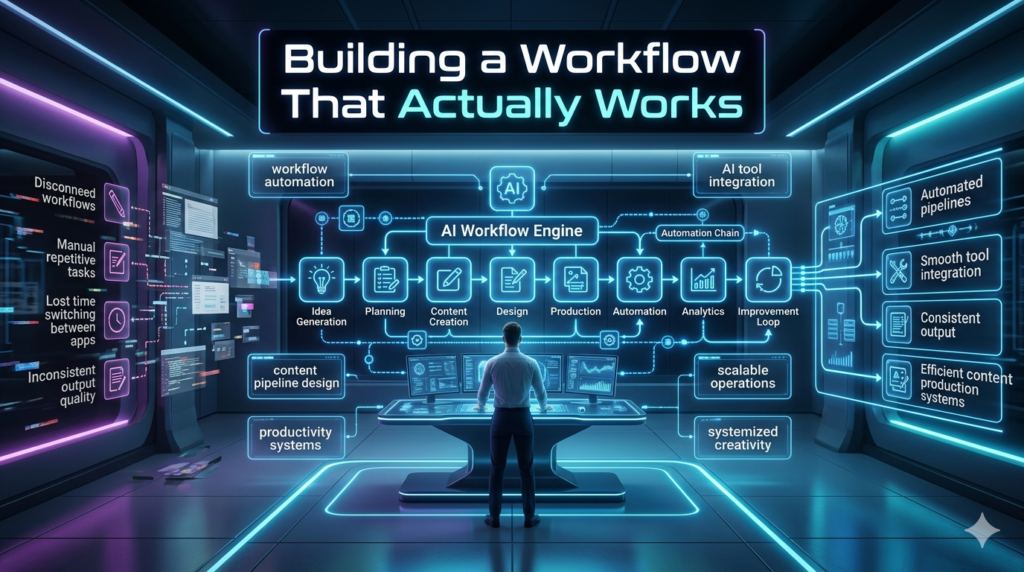
If I were starting from scratch today, I’d keep the stack lean. For keyword and competitive research, I’d lean on established platforms with robust AI add-ons think Ahrens’ AI search suggestions or SEMrush’s writing assistant. For content briefs and gap analysis, Clear scope or Surfer provides excellent directional guidance. Technical SEO at scale still belongs to crawlers like Screaming Frog or Site bulb, though their newer AI integrations can now summarize crawl issues in plain English instead of forcing you to decode 404 chains manually. The real magic happens in the handoffs. AI handles the research synthesis; the human shapes the angle. AI suggests the outline; the writer fills it with case studies, failures they’ve personally experienced, and opinions that might be controversial.
AI polishes grammar and consistency; the editor checks for tone and factual accuracy. Skip any of those human steps, and you’re not doing SEO you’re doing content assembly. Budget matters too. A solo operator running a local business doesn’t need a $500-a-month enterprise suite. Start with Google Search Console (free), pair it with a mid-tier optimization tool, and invest savings into actually paying a writer who knows your industry. Agencies managing fifty sites have different scalability needs, but even then, I’d argue that restraint beats bloat. Too many tools create conflicting data and decision paralysis.
The Bottom Line
AI SEO tools aren’t going anywhere, nor should they. They’ve democratized access to insights that were once locked behind expensive consultants and enterprise contracts. But they’re amplifiers, not replacements. In an era where search engines are desperate to surface authentic expertise, your competitive advantage isn’t the software you use it’s the judgment you apply to it.
The winners of the next few years won’t be the teams generating the most content. They’ll be the teams using artificial intelligence to remove friction, then spending their freed-up time doing the things AI can’t: interviewing customers, testing products, building original datasets, and telling stories that only they can tell.
FAQs
Q: Are AI SEO tools worth it for small businesses?
A: Yes, if you use them for research and optimization rather than full content automation. A single affordable tool can replace hours of manual keyword analysis.
Q: Can AI SEO tools replace human SEO professionals?
A: No. They excel at data processing and pattern recognition but lack strategic judgment, creativity, and real-world industry experience.
Q: Do AI SEO tools work with Google’s latest algorithm updates?
A: They can help, but only when guided by human expertise. Google’s recent updates specifically target low-quality, mass-produced content exactly what happens when tools are used without editorial oversight.
Q: What’s the best AI SEO tool for content optimization?
A: Surfer SEO, Clear scope, and Market Muse are all strong, depending on your budget and workflow. The best one is the platform your team will actually use consistently.
Q: Is AI-generated content penalized by Google?
A: Not automatically. Google penalizes unhelpful content regardless of how it’s produced. If AI-generated text lacks originality, accuracy, or value, it will struggle to rank.