
Remember the days when SEO was a simpler game? You’d optimize a page around a keyword, check where you landed on Google’s page one, and call it a win if you were in the top three. Those days are gone. Today, when you search for something like best running shoes for flat feet, you might not even see a traditional list of blue links. Instead, you’re met with an AI Overview a synthesized answer pulled from multiple sources followed by a carousel of product ads, a map pack for local stores, and maybe a FAQ section. The old playbook is obsolete. To navigate this new landscape, you need a new tool: an AI rank tracker.
I’ve been in digital marketing for over a decade, and I’ve watched the SERP (Search Engine Results Page) transform from a static list into a dynamic, AI driven experience. My wake up call came last year when a client who sold specialty kitchen gadgets saw a 40% drop in organic traffic overnight. Their top pages were still ranking #1 for their target keywords, but they weren’t getting clicks. Why? Because Google’s new AI-generated answers were satisfying user queries directly on the results page. That’s when I realized: tracking your position in a traditional sense is no longer enough. You have to track your presence in the AI-driven SERP features.
What Exactly Is an AI Rank Tracker?
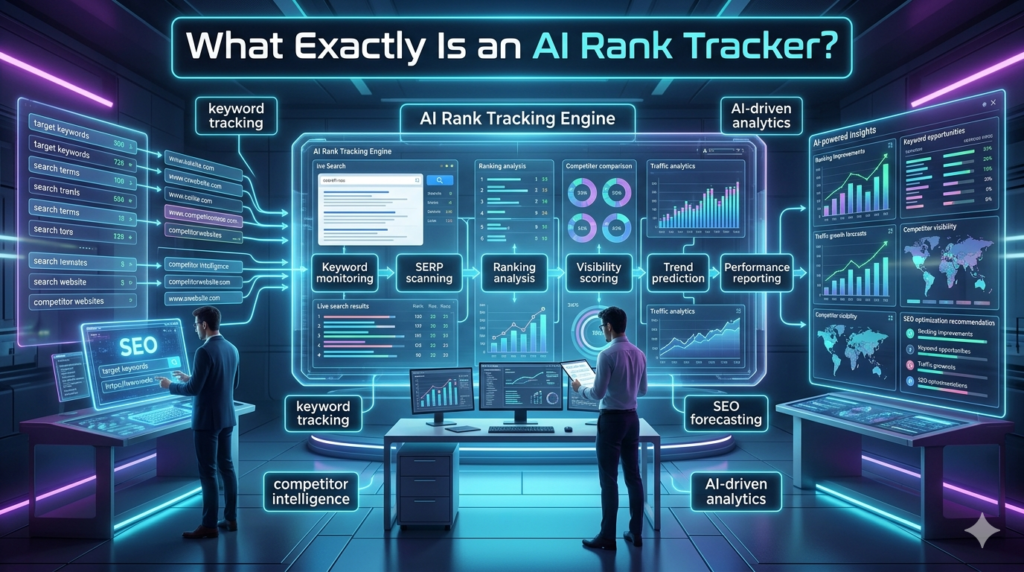
An AI rank tracker is a sophisticated SEO tool that goes beyond monitoring your URL’s position for a keyword. It analyzes how your content performs within the new ecosystem of AI-generated answers, knowledge panels, local packs, featured snippets, and other SERP features. It answers critical questions like: Is my brand mentioned as a source in an AI Overview? Am I appearing in the “People also ask” boxes? How does my visibility compare when the search results are dominated by Google’s own AI?
Traditional rank trackers are like using a paper map in the age of GPS. They tell you your position, but not the traffic conditions, road closures, or alternative routes. An AI rank tracker is the GPS it shows you the entire terrain, including the new highways (AI answers) that are diverting traffic away from the old roads (organic listings).
Why This Isn’t Just Another SEO Fad
Some marketers roll their eyes at every new SEO acronym, and rightly so. But this shift is fundamental. Google’s rollout of AI Overviews (formerly Search Generative Experience) and Bing’s deep integration of AI chat are not experiments; they are the new default. Data from Similar web and Gartner suggests that while overall search volume is growing, CTR (click-through rate) for traditional organic results is declining, especially for informational queries. If your strategy is built on ranking #1, you’re measuring the wrong thing.
I’ve seen this play out with a client in the personal finance space. They created an excellent guide to debt snowball vs. avalanche methods. For years, it ranked #2 for that keyword and brought consistent, qualified traffic. After Google’s AI began generating a concise comparison directly in the SERP, their CTR plummeted. They were still #2, but the click worthy real estate had moved up to the AI box itself. An AI rank tracker would have shown them not just their #2 position, but their absence from the AI answer that was now capturing 60% of the clicks.
How AI Rank Trackers Work: Beyond the Blue Links
These tools use a combination of techniques to give you the full picture:
- SERP Feature Detection: They don’t just scrape the top 10 URLs. They identify and catalog every element on the page: AI Overviews, featured snippets, knowledge panels, local packs, image packs, video carousels, ads, and more.
- Presence & Position Tracking: They track whether your domain or specific URLs appear within these features. For example, are you the source cited in an AI Overview? Are you listed in the local pack? This is often more valuable than a traditional #1-10 ranking.
- Share of Voice (SOV) in the AI Era: This is a game changer. Instead of just seeing your position, you see your visibility share across the entire SERP. A tool might show that while you rank #3 organically, you own 0% of the AI Overview’s cited sources, while a competitor owns 40%. That’s a massive opportunity gap.
- Keyword Cannibalization & Intent Mapping: AI trackters help you see if multiple pages from your site are competing for the same AI feature or if your content is misaligned with the dominant intent (informational vs. transactional) behind a keyword.
I use a tool called Rank Watch (no affiliation, just a satisfied user) for this. Recently, it alerted me that a client’s product page was ranking #1 for a commercial keyword, but an AI Overview was dominating the top of the page with a list of “top 5 alternatives.” My client wasn’t in that list. We shifted our strategy to create a comparison blog post targeting the AI Overview’s citation sources, and within two months, we were featured. The product page’s traffic didn’t drop it increased because we captured the early-click AI audience.
Choosing the Right Tool: It’s Not Just About Price
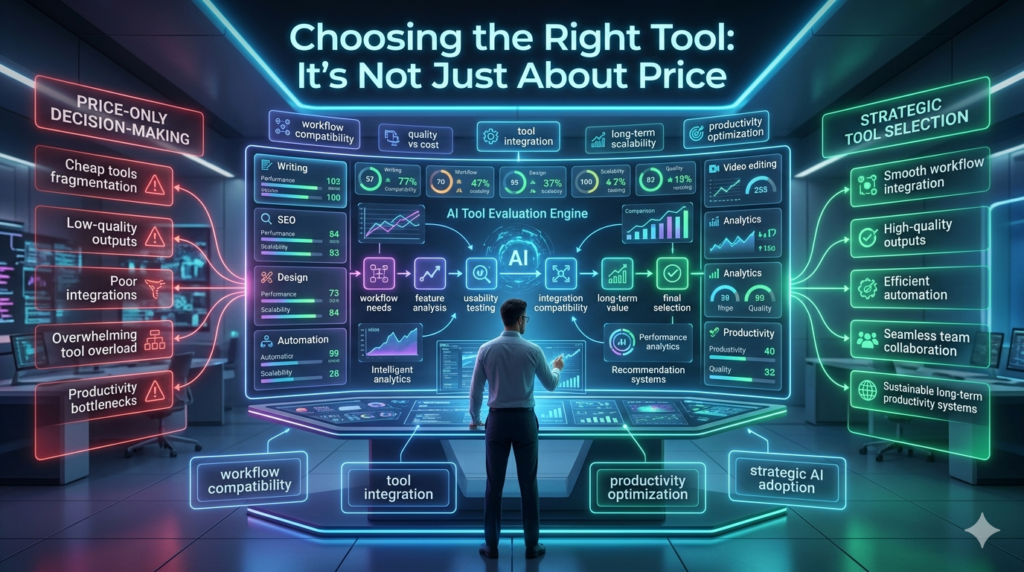
The market is responding with dedicated AI rank tracker solutions like Ace ranker, Night watch, and Seep stat, while traditional giants like SEMrush and Ahrefs are rapidly adding AI-focused features. When evaluating, look beyond the price tag:
- Accuracy of AI Detection: Does the tool reliably identify AI-generated content vs. a standard featured snippet? Some are better than others.
- Depth of SERP Analysis: Does it show you the content of the AI answer? Can you see which domains are being cited?
- Integration with Your Workflow: Can you connect it to Google Search Console, your analytics, and your content calendar? The insights are useless if they live in a silo.
- Local vs. Global Tracking: If you’re a local business, you need to know if you’re appearing in the local pack AI results, not just the global ones.
Ethical Considerations and the Trust Factor
As with any powerful tool, there’s a temptation to game the AI. But remember, these systems are built to reward expertise, authoritativeness, and trustworthiness (E-E-A-T). The most successful strategy isn’t about tricking an algorithm; it’s about creating genuinely superior content that deserves to be cited as a source. An AI rank tracker helps you audit your E-E-A-T.
Are you being cited? If not, why? Is your content too thin? Is your site’s reputation a barrier? There’s also the question of data privacy. These tools scrape Google’s results. Ensure your provider complies with Google’s terms of service and data protection regulations like GDPR. Reputable tools anonymize data and operate transparently.
The Bottom Line: Adapt or Become Invisible
The SEO professional who ignores AI rank tracking is like a retailer who only tracks foot traffic at their physical store but has no idea how many people are browsing their Google Business Profile or seeing their products in a local service ad. You’re measuring an incomplete reality. Start by auditing your current visibility. Pick 10-20 of your most important keywords and manually search them. See how many AI features dominate the page.
Then, invest in a tool that can automate this view. Use it not to panic, but to strategize. Shift some content resources from purely ranking for keyword X to becoming the source that AI pulls from for topic Y. The goal isn’t to outrank the AI. The goal is to become part of the AI’s answer. An AI rank tracker is your map to that new territory. Without it, you’re not just flying blind you might be flying in the wrong direction entirely.
FAQs
Q: Is an AI rank tracker a replacement for traditional rank tracking?
A: No. It’s a complement. You still need to know your organic positions, but you must layer that data with your visibility within AI features and SERP elements.
Q: How much do AI rank trackers cost?
A: Pricing varies widely, from around $50/month for basic tools to $500+/month for enterprise-grade platforms with deep analytics and large keyword limits.
Q: Can these tools guarantee my site will be featured in AI answers?
A: No tool can guarantee that. They provide data and insights. Your content quality, E-E-A-T, and alignment with user intent determine whether you’re cited.
Q: Do I need a separate tool, or can I use my current SEO suite?
A: Major suites like SEMrush and Ahrefs are adding these capabilities. If you’re already invested, start there. If you need deeper, more specialized AI tracking, a dedicated tool may be worth it.
Q: Is this just for big enterprise sites?
A: Absolutely not. Local businesses need this to see if they’re appearing in local pack AI results. Small blogs need it to see if their content is being synthesized into answers that steal clicks. Any website that relies on search traffic is affected.