
For years, my relationship with the blank page was a complex dance. Some days, ideas flowed like a river, words forming effortlessly into coherent narratives. Other days, it felt like pulling teeth staring at a blinking cursor, battling writer’s block, and questioning every sentence. This perennial struggle for efficiency and inspiration is, I believe, a shared experience for anyone who regularly puts words out into the world.
Then, something shifted. The digital landscape began offering new allies: advanced software platforms designed to assist with the very challenges I (and countless other bloggers, content creators, and marketers) faced daily. These smart blogging tools, often imbued with sophisticated analytical capabilities, aren’t just fancy word processors; they’re evolving co pilots for our content journeys.
What Exactly Are We Talking About? Unpacking “Smart Blogging Tools”
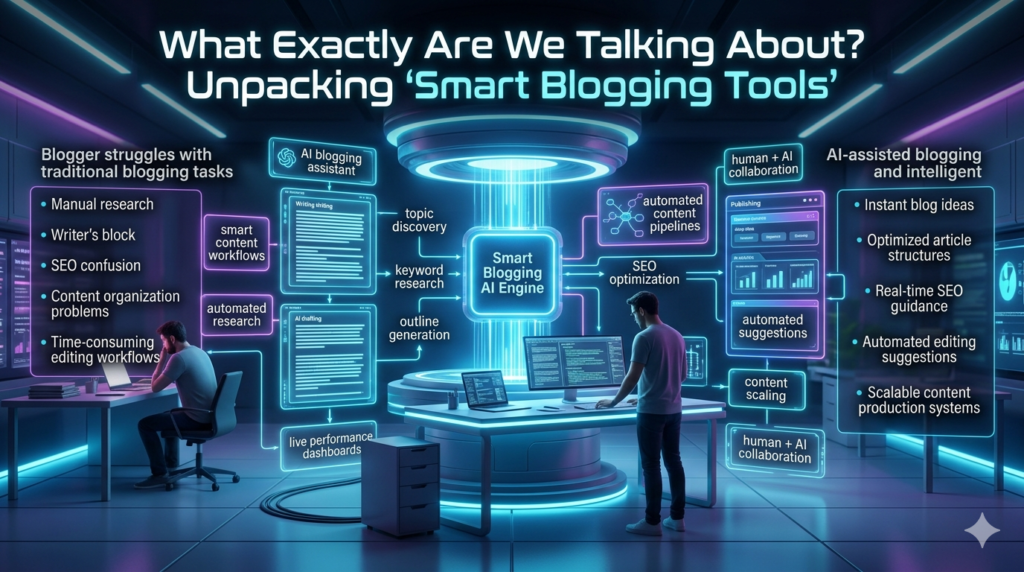
When I mention smart blogging tools, I’m referring to a suite of applications that leverage data analysis and pattern recognition to aid various stages of the blogging process. Think of them not as replacements for your brain, but as powerful extensions of it. These aren’t just glorified spell-checkers. They can help with:
- Idea Generation & Brainstorming: Ever felt like you’ve covered every possible angle on your niche? These tools can suggest fresh topics, related keywords, and even different perspectives based on current trends and audience interests.
- Outlining & Structure: Taking a sprawling idea and giving it shape is crucial. Many platforms can help structure an article, suggesting headings, sub-sections, and logical flows, saving you precious time grappling with organization.
- Drafting Assistance: This is where things get truly interesting. While they won’t write your entire masterpiece for you (nor should they, in my opinion), they can help draft initial sentences, expand on bullet points, rephrase awkward sentences, or even suggest transitions between paragraphs.
- Optimization for Search Engines (SEO): A blog post is only effective if people can find it. These tools often integrate robust SEO features, helping you identify primary and secondary keywords, analyze readability, and ensure your content has the best chance of ranking well.
- Grammar & Style Refinement: Beyond basic spell check, advanced linguistic analysis can catch nuanced grammatical errors, improve sentence clarity, and suggest stylistic improvements to make your writing more engaging.
In essence, they’re designed to streamline the mechanical and often time consuming aspects of content creation, freeing you up to focus on the truly creative and strategic elements.
My Experience: Where These Tools Truly Shine
From my own years in digital publishing, I’ve seen firsthand how these tools can transform a workflow. Take writer’s block, for instance. It’s a cruel mistress. I remember a specific instance where I needed to write about the intricacies of supply chain logistics a fascinating but often dry topic. My mind was drawing blanks. I turned to one of these platforms, feeding it my core topic. Within minutes, it presented me with a dozen unique angles, questions readers were asking online, and even a potential outline complete with subheadings like The Last Mile Challenge and Navigating Geopolitical Impacts. It didn’t write the article, but it kickstarted my brain in a way no amount of coffee or pacing ever could. The content I produced that day was far richer and more comprehensive than it would have been if I’d simply muscled through.
Another area where they’re invaluable is SEO optimization. In the past, optimizing an article felt like a dark art, a constant battle between what sounded natural and what Google’s algorithms wanted. Now, after I’ve drafted a piece, I can run it through a smart editor. It highlights areas where I could naturally integrate more related keywords, suggests improvements for sentence structure to enhance readability, and even points out opportunities for internal linking. This isn’t about keyword stuffing; it’s about intelligent enhancement that genuinely helps readers find valuable content. It’s about ensuring my hard work reaches the right audience.
The Unvarnished Truth: Where We Still Need the Human Brain
Now, let’s be absolutely clear. As much as I champion these digital assistants, I’m not here to tell you they’ll magically write your next bestseller or completely automate your blogging career. That would be a disservice to both you and the tools themselves. The biggest limitation? True originality, nuanced voice, and genuine empathy. These platforms excel at pattern recognition and data synthesis. They can analyze millions of existing articles and generate text that sounds plausible and coherent. But they cannot feel, they cannot truly innovate in the human sense, and they certainly cannot inject the unique spark of your personality, your lived experience, or your singular perspective into a piece.
I once experimented by asking a tool to write an opinion piece on a controversial social issue. The result was well-structured, grammatically perfect, and entirely bland. It presented both sides fairly, but lacked any conviction, any personal stake, any soul. It was the intellectual equivalent of lukewarm water. That’s where the human writer’s input becomes not just valuable, but utterly indispensable. We bring the emotion, the unique angle, the persuasive power, and the ethical grounding.
How I Integrate Them: A Co-Pilot, Not an Auto-Pilot

My approach to using smart blogging tools is simple: think of them as highly skilled co pilots, not auto pilots. I’m always in command, dictating the destination, setting the course, and making critical decisions.
- I start with my unique insight: Before I even open a tool, I have a core idea, an opinion, or a piece of research I want to share. This is my starting point, my contribution.
- I use them for acceleration: When brainstorming feels sluggish, or an outline is elusive, I’ll feed my core idea into a tool to get some initial prompts or structural suggestions. This jump starts the process.
- I draft the heart of the content: The core arguments, the personal anecdotes, the distinct voice that all comes from me, directly onto the page.
- I lean on them for refinement and optimization: Once my human draft is complete, I’ll use the tools for readability checks, SEO suggestions, grammar polishing, and sometimes to help rephrase a clunky sentence. They act as an extra pair of analytical eyes.
- Human editing is non-negotiable: Every piece of content, regardless of how much assistance it received, undergoes thorough human review, editing, and fact-checking before it sees the light of day. This is the final, critical layer of quality control and authenticity.
The Future is Hybrid
The content creation landscape is continuously evolving. What’s clear to me is that the future of blogging, and indeed much of digital publishing, is a hybrid one. It’s not about machines replacing people, but about smart tools augmenting human ingenuity. These tools are democratizing content creation to some extent, allowing more voices to be heard by lowering the barrier to entry for quality and efficiency.
For those of us dedicated to crafting compelling narratives, our role isn’t diminished; it’s amplified. We become less bogged down by the mundane, more focused on crafting truly impactful, resonant content that carries our unique fingerprint. The ultimate goal, after all, remains unchanged: to connect with an audience, share valuable insights, and tell stories that matter. And in that endeavor, a smart digital assistant can be a truly powerful partner.
FAQs
Q: What exactly are “smart blogging tools”?
A: They are software applications that use advanced data analysis to assist bloggers with various tasks like idea generation, outlining, drafting, and optimizing content for search engines and readability.
Q: Can these tools write entire blog posts for me?
A: While some can generate coherent text, they generally lack true originality, unique voice, or deep understanding. They are best used as assistants or co-pilots, not as full replacements for human writers.
Q: How do these tools help with SEO?
A: They can analyze your content for keyword opportunities, suggest related terms, check readability, and provide recommendations to improve your article’s chances of ranking well in search engine results.
Q: Are there ethical concerns when using these tools?
A: Yes. It’s crucial to maintain transparency with your audience, fact-check all information, and ensure the content reflects your own authentic voice and values. Over-reliance can also stifle creativity.
Q: Will using these tools make my writing sound generic?
A: Not if used correctly. If you guide the tool, inject your unique perspective, and perform thorough human editing, your writing can maintain its distinct voice while benefiting from the tool’s efficiency and optimization capabilities.
Q: Are these tools suitable for beginners or only experienced bloggers?
A: They can be beneficial for both. Beginners can use them to learn best practices and overcome initial hurdles, while experienced bloggers can leverage them for efficiency and scaling content production.