
Let me be honest with you when I first heard about AI copywriting tools, I rolled my eyes. Another tech buzzword promising to revolutionize writing? Please. But after spending months testing, tweaking, and sometimes tearing my hair out over these platforms, I’ve come around. Not because they’re magic (they’re not), but because used right they can seriously lighten your load.
Whether you’re a solopreneur drowning in product descriptions, a marketer juggling 10 campaigns at once, or even a seasoned copywriter looking to break through creative blocks, AI tools are becoming hard to ignore. The trick? Knowing what they do well… and where they fall flat on their digital face.
What Exactly Are AI Copywriting Tools?
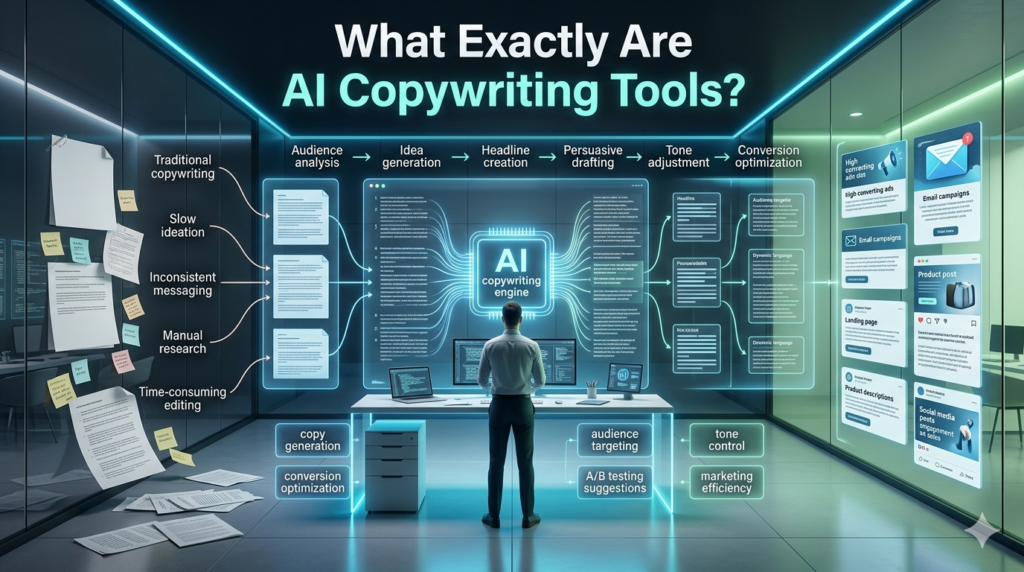
At their core, these are software platforms powered by large language models (like GPT-4, Claude, or Gemini) that generate written content based on prompts. You feed them a few keywords, a tone preference, maybe a target audience and boom, out pops headlines, email subject lines, social posts, blog intros, even full articles.
Popular names you’ve probably seen: Jasper, Copy.ai, Writes ontic, Any word, Rite, and the ever-present ChatGPT. Some specialize in ads. Others nail long-form SEO blogs. A few even claim to write like humans which, let’s be real, is still a stretch.
Where They Shine (And Save Your Sanity)
I’ll never forget the time I had to write 87 product descriptions for an e-commerce client in two days. No joke. I fired up Jasper, fed it brand voice guidelines, pasted specs from a spreadsheet, and within an hour, I had rough drafts for all 87. Were they perfect? Nope. But they gave me a solid foundation to tweak, polish, and inject personality into. What would’ve taken me three all-nighters took one focused afternoon.
That’s the real value: acceleration, not replacement.
Here’s where I’ve found AI copy tools most useful:
- Beating blank-page syndrome: Staring at a blinking cursor? Throw in a prompt like “Write five playful Instagram captions for a new line of vegan protein bars.” Instant momentum.
- Scaling repetitive content: Product pages, meta descriptions, FAQ sections if it’s templated or formulaic, AI can churn out decent first drafts fast.
- A/B testing variations: Need 10 versions of a Facebook ad headline? Done in 30 seconds. Test them, see what sticks, iterate.
- Tone shifting: Writing for Gen Z on TikTok vs. corporate execs on LinkedIn? AI can adjust voice surprisingly wel if you give it clear direction.
One of my clients, a boutique skincare brand, used Copy.ai to generate 200+ Pinterest pin descriptions in under an hour. Their engagement jumped 22% the next month not because the AI was brilliant, but because they finally had enough content to test, optimize, and stay consistent.
Where They Still Suck (And Why You Can’t Fully Trust Them)
Let me be blunt: AI doesn’t understand nuance, emotion, or cultural context the way humans do. It mimics patterns brilliantly, sometimes but it doesn’t feel. And in copywriting, feeling matters. I once asked an AI tool to write a heartfelt Mother’s Day email for a jewelry brand. The output? Generic fluff like “Celebrate the woman who gave you everything!” with zero personalization, no storytelling, no emotional hook. It read like a Hallmark card written by a robot. (Because it was.)
Other pitfalls I’ve run into:
- Factual inaccuracies: AI confidently makes stuff up. I’ve caught tools inventing product features, misquoting stats, even fabricating expert quotes. Always fact-check.
- Brand voice drift: Without tight guardrails, AI defaults to bland, corporate speak. You need to train it repeatedly with examples and feedback.
- SEO over substance: Some tools prioritize keyword stuffing over readability. I’ve seen outputs so awkwardly optimized, Google might rank them… but humans won’t read past the first sentence.
- Ethical gray zones: Who owns AI-generated content? Can you copyright it? Is it plagiarism if it’s trained on someone else’s work? The legal landscape is still messy.
How to Use Them Like a Pro (Not a Lazy Hack)
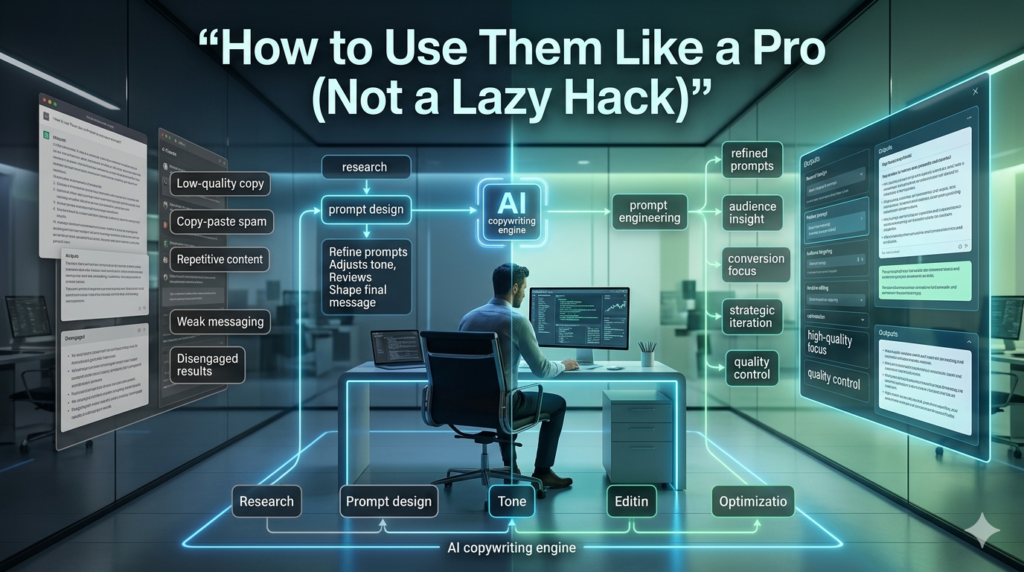
After dozens of failed experiments, here’s my battle-tested workflow:
- Start with a crystal-clear brief: Don’t just say write a blog. Say: “Write a 600-word beginner’s guide to sourdough baking for busy parents. Tone: encouraging, slightly humorous. Include 3 subheadings. Target keyword: ‘easy sourdough recipe.’ Avoid technical jargon.”
- Use AI for the middle, not the edges: Let it handle the heavy lifting of structure and draft generation. Then you add the soul: personal anecdotes, industry insights, emotional hooks.
- Edit ruthlessly: Treat AI output like a first-year intern’s draft promising, but needs heavy supervision. Trim fluff. Inject specificity. Add your voice.
- Train your tool: Most platforms let you save brand voices or custom templates. Feed them your best performing content. The more you refine, the better it gets.
- Never skip human review: Grammar checkers miss tone. AI misses intent. Always have a real person preferably you read before hitting publish.
The Future? Hybrid Humans.
Look, AI isn’t coming to steal your job. It’s coming to take over the parts of your job you hate anyway the repetitive, the tedious, the uninspired. That frees you up for strategy, creativity, and the kind of human connection no algorithm can replicate. The most successful marketers and writers I know? They’re not resisting AI. They’re bending it to their will. Using it as a co-pilot, not a captain. Is it perfect? Far from it. But it’s getting better fast. And ignoring it is like refusing to use spellcheck in 1995. Possible, but painfully inefficient.
Final Thought
AI copywriting tools won’t replace great writers. But writers who use AI well? They’re going to outpace those who don’t. The key is staying in the driver’s seat. Use the machine for horsepower. You provide the steering, the vision, and most importantly the humanity.
FAQs
Q: Are AI copywriting tools worth the money?
A: If you’re producing high volumes of content regularly, yes. For occasional use, free tools like ChatGPT may suffice.
Q: Can Google detect AI content?
A: Not directly but it can spot low-quality, generic, or spams content. Focus on adding unique value, and you’ll be fine.
Q: Do I need to disclose AI use?
A: Ethically? Sometimes. Legally? Usually not unless you’re in regulated industries (finance, health). When in doubt, transparency builds trust.
Q: Which tool is best for beginners?
A: Try Copy.ai or Rite they’re user-friendly, affordable, and great for short-form content.
Q: Will AI make human copywriters obsolete?
A: No. It’ll eliminate lazy writing, though. The bar for creativity and strategic thinking just got higher.